
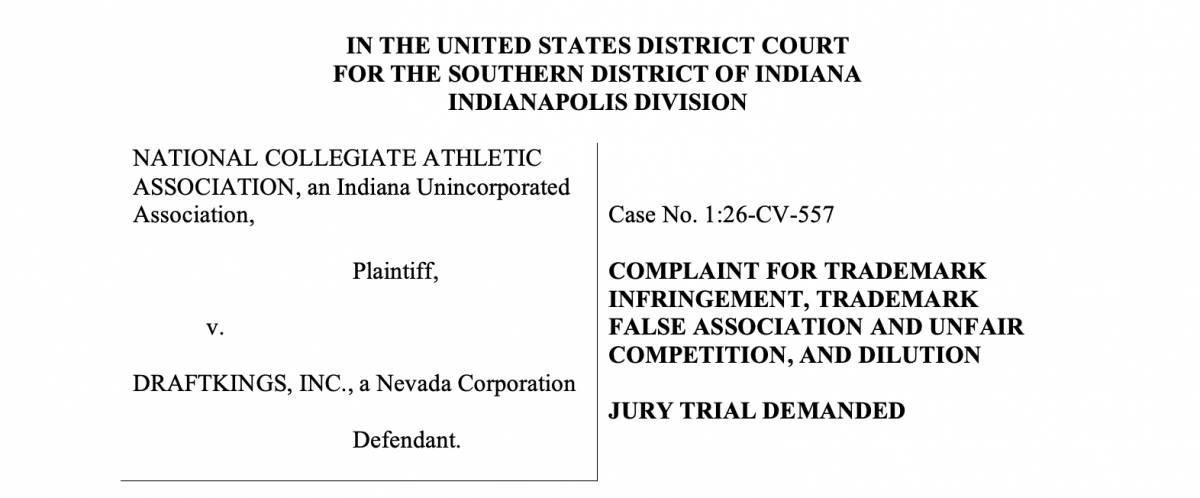
The NCAA filed a federal lawsuit against DraftKings on March 20, 2026, seeking an emergency temporary restraining order to stop the sports betting giant from using MARCH MADNESS®, FINAL FOUR®, ELITE EIGHT®, and NCAA SWEET SIXTEEN® in connection with its wagering products, promotional campaigns, and marketing activities. The case, filed in the Southern District of Indiana (Case No. 1:26-CV-557), lays out three counts under the Lanham Act: trademark infringement (§ 1114), false association and unfair competition (§ 1125(a)), and dilution by tarnishment (§ 1125(c)).
The NCAA Has Been Here Before — Sort Of
I’ve covered the NCAA’s trademark enforcement posture for years, and two prior cases are worth revisiting in this context.
In 2018, I wrote for Forbes about the NCAA’s lawsuit against the owners of “Markdown Madness” — a promotion used by car dealerships timed to coincide with the Tournament. The NCAA alleged that consumers might be confused into thinking the association had something to do with selling used vehicles. I noted at the time that the NCAA had actually missed its window to oppose the Markdown Madness registration back in 2014, and the lawsuit was partly a consequence of its own delay.
Then, in 2021, I covered for Above the Law that the NCAA’s petition to cancel the trademark registration for “Vasectomy Mayhem,” owned by a Virginia urology center. The NCAA had and has a hard time figuring out which battles were worth fighting. The notion that anyone would confuse a vasectomy promotion with the college basketball tournament, or that a urology center’s use of “Mayhem” would dilute the famous March Madness marks, was a stretch.
That said, the DraftKings case is a different animal entirely. And the distinction matters.
What the Complaint Actually Alleges
The complaint is detailed and supported by screenshots (dozens of them) pulled directly from DraftKings’ website and mobile app. The evidence shows the marks being used as navigation tabs, section headers, promotional banners, and parlay labels across the platform. Specific examples include a “March Madness” tab as a primary menu item, a “Final Four Round One” parlay label, “To Reach the Sweet 16” and “To Reach the Elite 8” as bet category headers, and “MARCH MANIA” as the name of a survivor contest with its own official rules page.
The NCAA also alleges that DraftKings embedded the marks in metatags and search engine optimization, meaning that consumers searching for the NCAA’s marks online could encounter DraftKings advertising alongside official NCAA content. Note that purchasing trademarked search terms, on its own, may not constitute infringement.
On the dilution count, the NCAA isn’t breaking new ground. It cites a 2001 Eastern District of Virginia decision that previously found use of MARCH MADNESS® in connection with gambling services constitutes tarnishment. The NCAA further argues that associating its marks with commercial gambling directly undermines decades of its “Draw the Line” anti-gambling campaign and its formal prohibition on sportsbook sponsorships.
The Claims in Brief
Count I — Trademark Infringement (15 U.S.C. § 1114): This is the core claim. The NCAA holds incontestable registrations for most of its Basketball Marks, which under § 1115(b) constitutes conclusive evidence of validity, ownership, and exclusive right to use. The NCAA argues DraftKings’ use creates a likelihood of confusion as to whether the NCAA is affiliated with or endorsing the gambling platform.
Count II — False Association and Unfair Competition (15 U.S.C. § 1125(a)): This count focuses on the false impression that the NCAA has sponsored, authorized, or endorsed DraftKings’ products, which is a particularly potent argument given the NCAA’s very public, years-long stance against sports betting.
Count III — Dilution by Tarnishment (15 U.S.C. § 1125(c)): Tarnishment occurs when a famous mark’s reputation is harmed by association with inferior or unsavory goods or services. The NCAA argues that linking its marks to commercial gambling is precisely the kind of harm Congress intended the dilution statute to address.
The NCAA is seeking a preliminary and permanent injunction, disgorgement of profits, actual damages, treble damages, and attorneys’ fees, and has designated this an “exceptional case” under § 1117(a) based on what it characterizes as DraftKings’ willful and intentional conduct.
The Defenses Worth Watching
DraftKings hasn’t yet answered the complaint, but two potential defenses are worth examining closely.
Nominative Fair Use. The classic argument here is that DraftKings needs to use the NCAA’s marks to identify the subject matter of its wagering products. They would essentially be saying that you cannot describe betting on the NCAA Tournament without using “March Madness” or “Final Four.” Under the traditional three-part test, nominative fair use requires that: (1) the product or service not be readily identifiable without the mark; (2) only so much of the mark is used as necessary to identify it; and (3) the user does nothing to suggest sponsorship or endorsement. Prong three is where DraftKings may have a problem. The complaint’s screenshots show these marks used as prominent navigation tabs, promotional labels, and contest names, not as neutral references to identify the subject matter of a wager.
Use as a Trademark. Perhaps the more interesting threshold question is whether DraftKings is using these marks as marks at all — that is, as source identifiers rather than as descriptions of the thing being wagered on. Trademark infringement requires trademark use. If DraftKings can frame its use as purely informational or descriptive (i.e., “here is where you can bet on the games in this round of the tournament”), the infringement claim collapses before you even reach likelihood of confusion. The strongest version of this argument is targeted at specific uses. A navigation tab labeled “March Madness” in a betting menu arguably functions as a content descriptor, not a source indicator. The complaint, however, is careful to document uses that go well beyond the purely descriptive, including “MARCH MANIA” as the branded name of a DraftKings-specific survivor contest, which is plainly not a reference to an NCAA product but a DraftKings product name that deliberately evokes the NCAA’s marks.
The NCAA anticipated this defense. The complaint explicitly alleges that DraftKings does not need to use these marks. It notes that DraftKings and similarly situated competitors routinely use descriptive alternatives like “the Division I basketball tournament,” “NCAA tournaments,” or “NCAA college basketball tournaments” to refer to the events without infringement.
Why This Case Is Different from Markdown Madness and Vasectomy Mayhem
The prior enforcement actions I covered involved marks used in entirely different commercial contexts (car sales and medical services), where consumer confusion was a genuine stretch, and the dilution theory required significant imagination. DraftKings operates in the exact space the NCAA has most aggressively tried to separate itself from. The NCAA has declined sportsbook sponsorship revenue, banned college athletes and staff from sports betting, and actively lobbied state regulators to prohibit prop bets on college athletes. Its entire enforcement architecture against DraftKings is built around that institutional stance.
The screenshots in the complaint also show something qualitatively different from the prior cases. The marks are being used directly on a platform that processes real-money bets on the exact competitions the marks identify. This is not analogous to a car dealer running a “Markdown Madness” promotion during March. This is the NCAA’s own championship branding being embedded into a gambling product that wagers on the NCAA’s own championship games.
Heitner Legal and Trademark Protection
At Heitner Legal, trademark protection is core to what we do for people who have built valuable brands that deserve vigorous defense. Whether you are seeking registration of a new mark, enforcing against infringers, or navigating a complex situation involving fair use, descriptive use, or dilution, our team has the experience to advise you at every stage. Contact us for information.
(Heitner Legal is not involved in the NCAA v. DraftKings matter.)