
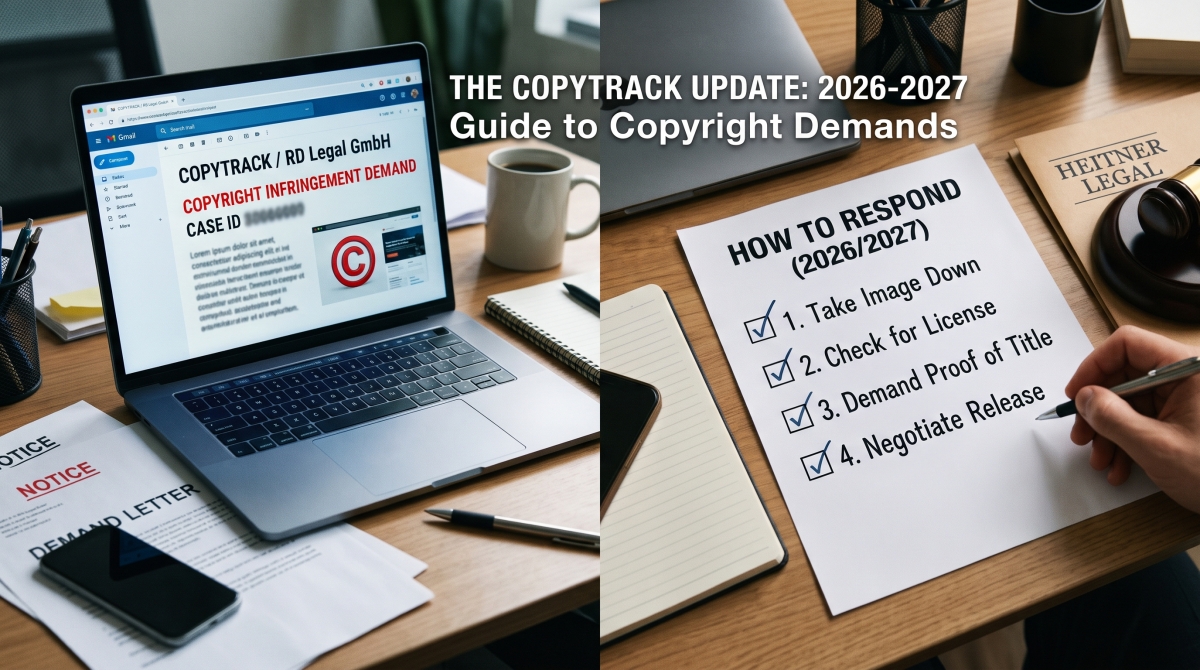
In 2022, we published a short guide on what to do if you get a Copytrack copyright demand letter. A lot has changed since then. The company now operates as RD Legal GmbH. It has appeared as a plaintiff in U.S. federal court. And its emails are still landing in inboxes across the country every week. If you receive such an email, then feel free to contact us.
This is the 2026 and 2027 update. If an email from Copytrack is sitting in your inbox right now, here is what it is, what it is not, and how to respond without overpaying.
Who Is Copytrack?
Copytrack is a Berlin-based image enforcement company, founded in 2015. In 2025, the operating entity was renamed RD Legal GmbH, and the Copytrack name continues as a brand. You will see both names in the signature block of current emails, along with a “Legal Department” sign-off.
Copytrack is not a law firm. Photographers and photo agencies upload their portfolios, and Copytrack’s software crawls the internet looking for matches. When it finds one, it sends a demand. It works on a success-fee model and keeps 45% of what it recovers after enforcement costs, according to its published terms.
That business model matters. A volume-driven, automated system will sometimes flag images the recipient actually licensed, images from free stock sites, or images that only look similar. Copytrack’s own terms require its clients to verify their chain of rights before submitting a case. Do not assume that happened.
What the Emails Look Like, and Where They Lead
The first email typically identifies the photographer or agency, attaches a screenshot of the image on your site, and sends you to portal.copytrack.com with a Case ID. The portal offers two prices: one to pay for past use and take the image down, and a higher one for a license that also covers continued use. It accepts credit card and PayPal.
If you do not pay, the sequence usually runs like this:
- Initial demand with a short response window and a portal link.
- Reminders, often titled “1st Reminder” and “2nd Reminder,” with firmer language. Some reminders say you never contacted them even after you or your lawyer did. That is an automated system talking, not a person who read your reply.
- Threat of referral to “one of our partner law firms in your jurisdiction.”
- A U.S. lawsuit, in a small number of cases.
That last step is real. In 2023, Copytrack GmbH joined European photographers as a co-plaintiff in at least three Florida federal cases:
- Ullrich Gnoth Foto-Grafik-Design and Copytrack GmbH v. First Elite Insurance, LLC, No. 5:23-cv-69 (M.D. Fla.)
- DPG Media BV, Pro Shots Photo Agency BV and Copytrack GmbH v. Parker Associates (M.D. Fla.), later voluntarily dismissed
- Orange Pics BV and Copytrack GmbH v. EVTV Miami, Inc., No. 1:23-cv-24223 (S.D. Fla.)
In Gnoth, the complaint alleged that the photographer had assigned the image’s enforcement rights to Copytrack, which let it sue alongside him. So when a reminder says the matter may go to a law firm, take it seriously. Just do not let it scare you into paying the first number on the portal.
Is the Claim Valid? Four Questions to Ask
1. Does the claimant own the image, and can it prove it? Ask for the chain of title: who took the photo, and the written authorization giving Copytrack the right to act. Automated matching gets it wrong more often than you would think, especially with free stock and lookalike images.
2. Did you have a license? Check old invoices, stock site accounts (Adobe Stock, Shutterstock, iStock), web designer contracts, and theme files. A valid license ends the conversation. Copytrack’s terms say a case may close when a valid license existed.
3. Is the image registered with the U.S. Copyright Office? This is the question Copytrack least likes to answer. In October 2026, when we asked for the registration on a pending claim, Copytrack replied that registration “is not a prerequisite for the present correspondence” and that its demand was an “authorization inquiry and an out-of-court resolution.” That is a revealing answer. Registration matters in two ways:
- Filing suit. For a U.S. work, registration is required before suing (17 U.S.C. § 411(a); Fourth Estate v. Wall-Street.com, 2019). Most Copytrack images come from European photographers, though, and foreign Berne Convention works are exempt. The Gnoth court relied on exactly that exemption for a German photo.
- What they can recover. Without a timely registration, statutory damages (up to $150,000 for willful infringement) and attorney’s fees are generally off the table under 17 U.S.C. § 412. The claimant is left with actual damages, usually a reasonable license fee.
4. What is the image actually worth? Gnoth is the best data point. The plaintiffs sued over one photo on a Facebook page after sending at least ten notices that went unanswered. They asked for $6,000 by stacking multipliers for duration, scarcity, and willfulness onto a $499 license fee. Even though the defendant never showed up, the court awarded $499 in actual damages plus $467 in costs (Report and Recommendation, Nov. 15, 2023). It rejected the scarcity multiplier and held that a willfulness multiplier is not available for actual damages.
Two more points. The statute of limitations is three years under 17 U.S.C. § 507(b), though courts apply a discovery rule, so an old image is not automatically safe. And fair use or de minimis use can apply in the right facts, but neither is a reason to ignore the letter.
How to Respond, Step by Step
- Do not pay through the portal yet. The portal price is an opening number, not a court-tested value.
- Screenshot the use, then take the image down. Preserve evidence of where it appeared and for how long. Then remove it from the page, the media library, and the server. Continued use after notice only strengthens their hand.
- Search for a license. Look through stock accounts, designer agreements, and old emails. If you find one, send it and ask that the case be closed.
- Demand proof. Ask for the chain of title, Copytrack’s written authorization, and any U.S. copyright registration with its effective date. Their answer tells you what remedies they actually have.
- Respond in writing, once and clearly. Expect form replies. Keep everything in one thread.
- Negotiate from the real number. Anchor to a reasonable license fee for that image and that use, not the portal price.
- Get a real release. Any payment should come with a written release covering the photographer, the agency, and Copytrack (RD Legal GmbH), for all past use of that image.
Mistakes We See Most Often
- Ignoring it. The Gnoth defendant ignored ten messages and ended up with a federal judgment and a permanent injunction. The dollar amount was small. The judgment was not.
- Paying the license option to make it go away. You do not need a forward-looking license if the image is coming down.
- Admitting things in the portal. Do not type explanations, apologies, or guesses about who uploaded the image into a system built to collect payments.
- Blaming the web designer, then doing nothing. You may have a claim against whoever put the image on your site. That does not stop the claim against you.
- Treating Copytrack like a scam. It has been criticized and investigated in Europe. Italy’s competition authority closed its inquiry in 2024 after Copytrack committed to changes, without finding a violation. It is a real company with real claims, some strong and some weak.
Frequently Asked Questions
Is Copytrack legit? Yes, in the sense that it is a registered German company acting on behalf of real rights holders. Whether a particular claim is valid, and what it is worth, is a separate question.
What is RD Legal GmbH? It is the current name of the company behind Copytrack, as renamed in 2025.
Can Copytrack sue me in the United States? It has, as a co-plaintiff with photographers, in Florida federal court.
Do I have to pay what the portal says? No. The portal price is a demand, not a judgment.
I already took the image down. Am I done? Not necessarily. Removal stops future exposure but does not resolve the claim for past use.
How Heitner Legal Can Help
We handle image demand letters every week, from Copytrack and from PicRights, Higbee & Associates, Visual Rights Group, and many others. We know what these claims are worth and how to close them with a proper release.
If you received a Copytrack email, send it to darren@heitnerlegal.com before you click anything in the portal.