
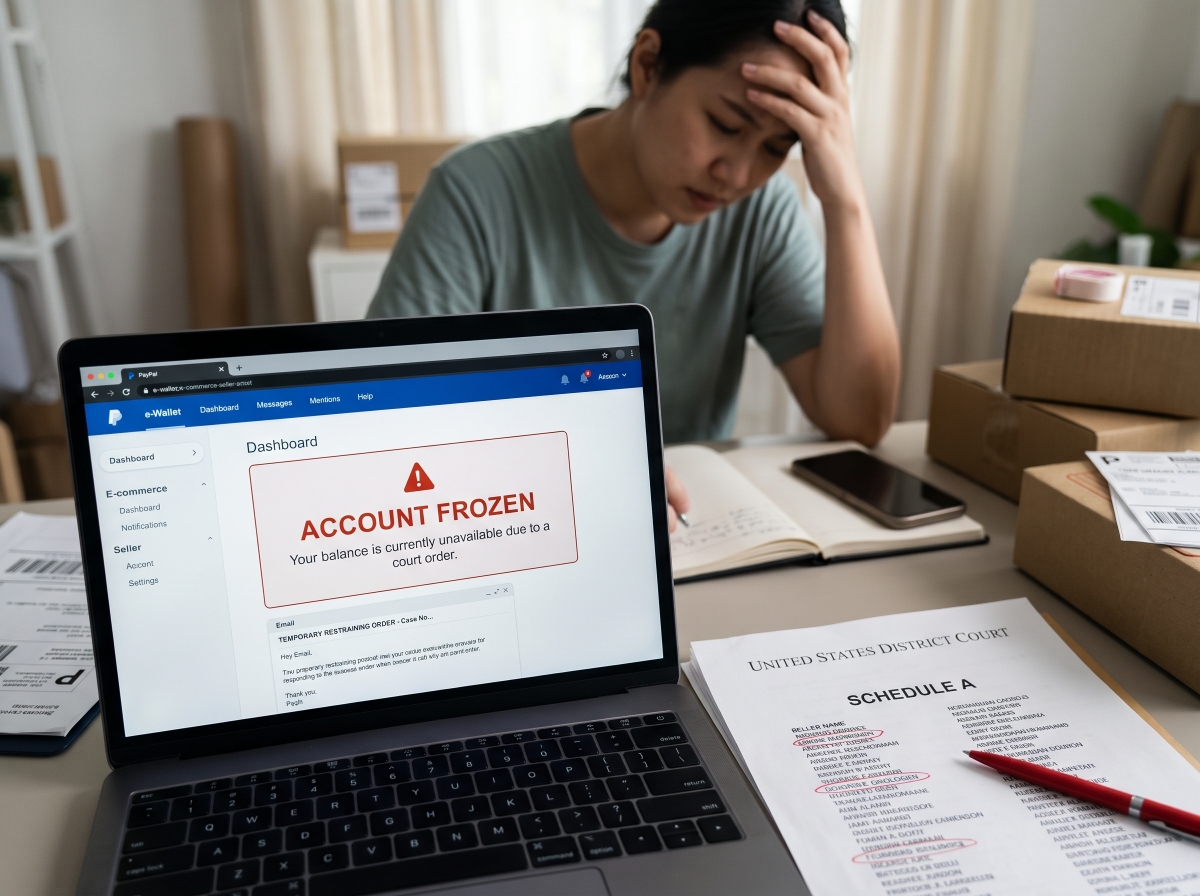
Did you log in to PayPal, Amazon, Walmart, or Temu this morning and find your balance frozen? Did an email arrive from a law firm you have never heard of, attaching a federal court order with your store name buried on a spreadsheet called “Schedule A”?
You are not alone. Every week, sellers across the world find themselves restrained by a temporary restraining order (TRO) entered without notice in a federal court in Chicago, Miami, or Pittsburgh. The money is not gone. But the clock is running, and what you do in the next few days will shape how this ends.
This guide explains how these cases work, what to do in the first 72 hours, and the defenses that sellers still have. Courts have grown far more skeptical of Schedule A tactics since 2024, and that matters for you.
What Is a Schedule A Lawsuit?
A Schedule A lawsuit is a single federal case filed by a brand, artist, or patent owner against dozens or hundreds of online stores at once. The defendants are not named in the complaint. Instead, they are listed by seller name and storefront URL on an attachment, usually labeled “Schedule A,” which is often filed under seal.
The claims are typically trademark counterfeiting, copyright infringement, or design patent infringement. Most plaintiffs ask for statutory damages, which can reach $2 million per counterfeit mark under the Lanham Act and $150,000 per willfully infringed work under the Copyright Act.
How the freeze happens
The playbook runs in a predictable order:
- The plaintiff files the case and asks the judge for an ex parte TRO, meaning without telling you first.
- The TRO orders marketplaces and payment processors (PayPal, Amazon, Walmart, Stripe, and others) to freeze the accounts tied to every store on Schedule A.
- Once the money is locked, the plaintiff serves you by email, usually with a link to the complaint and the order.
- A preliminary injunction hearing follows. A TRO issued without notice generally expires within 14 days unless extended, so the plaintiff will ask the court to convert it into a longer-lasting injunction.
- If you do nothing, the plaintiff seeks a default judgment and asks the court to transfer your frozen funds to satisfy it.
The frozen balance is the plaintiff’s leverage. Most settlement demands arrive within days of the freeze, and they are often priced with that leverage in mind rather than the actual sales of the accused product.
The First 72 Hours: What to Do Right Now
Speed matters more here than in almost any other kind of IP dispute. Work through these steps in order.
- Find the case. Your PayPal or Amazon notice should include a case number and court. Write down the exact caption, the judge, and the plaintiff’s law firm. If the notice has no case number, ask the platform for it in writing.
- Get the order and the complaint. Read the TRO itself. Note the date it was entered, when it expires, and the date of any preliminary injunction hearing. Those dates drive everything else.
- Confirm you are actually on Schedule A. Ask plaintiff’s counsel for the unsealed Schedule A or the line item for your store. Sellers are sometimes restrained by mistake, or because a related account was swept in.
- Do not move money or open new accounts to get around the freeze. Courts treat that as contempt, and it destroys any argument that the freeze was unnecessary.
- Pull your sales data for the accused product. Export every order, unit count, and dollar amount for the listing at issue. In many cases, the real number is a small fraction of what is frozen.
- Take down or pause the accused listing. This does not admit liability. It stops the clock on any further alleged infringement and shows good faith to the court.
- Preserve everything. Save supplier invoices, product photos, design files, licenses, and any proof that you created or authorized what you sold. Do not delete listings or messages.
- Do not respond to the settlement demand on your own. The first number you hear is rarely the best number available, and anything you write can be used against you.
- Talk to a lawyer before the hearing date. If you want to oppose the preliminary injunction or limit the freeze, your filing usually has to be on file before that hearing.
Your Options After a Schedule A Freeze
You are not limited to paying whatever the plaintiff demands. Depending on the facts, sellers have several paths, and they are often used together.
1. Negotiate a settlement based on real numbers
Many cases end in a negotiated settlement that releases the freeze and dismisses your store. The leverage shifts once the plaintiff sees actual sales data, a takedown, and a lawyer prepared to oppose the injunction. A good settlement includes a full release, a dismissal with prejudice, and written instructions to the platform to lift the restraint.
2. Ask the court to release funds that exceed any possible recovery
A freeze is meant to preserve what the plaintiff might recover, not to lock up your entire business. Courts have long held that prejudgment asset freezes generally require an equitable remedy, such as an accounting of profits. If your sales of the accused item were modest, a motion to modify the restraint can unlock the rest.
3. Oppose the preliminary injunction
There are rulings (not mentioned here) that give sellers real arguments to raise.
4. Challenge joinder
Sharing a trademark or a design patent with other sellers does not make you part of the same transaction. Courts have severed or dismissed improperly joined defendants. Be aware that courts are watching both sides. In 2026, one judge ordered limited discovery into whether supposedly unrelated defendants were coordinated after the same lawyer filed near-identical misjoinder motions for roughly 290 defendants.
5. Contest personal jurisdiction and service
If you never sold to the forum state, or the plaintiff skipped the diligence courts require before email service, those are defenses. A seller in Roblox Corp. v. BigFinz obtained dismissal for lack of personal jurisdiction and an award of attorneys’ fees.
6. Recover damages for a wrongful restraint
When a plaintiff restrains the wrong store, courts can award fees and costs. The bond the plaintiff posted for the TRO may also be available to you.
Common Mistakes Sellers Make
- Ignoring the email because it looks like spam. Email service is often court-authorized. Ignoring it leads to default, and default leads to the court handing over your frozen balance.
- Paying the first demand. Opening demands are frequently set by what is frozen, not by what you sold.
- Assuming an overseas location makes you immune. The freeze already reaches your U.S.-facing accounts, and a default judgment can follow you to future accounts on the same platform.
- Opening a new store to keep selling. Platforms link accounts, and a new store can be added to the same case.
- Waiting for the platform to fix it. PayPal and Amazon will not lift a court-ordered restraint on their own. Only the court or the plaintiff can release it.
Frequently Asked Questions
Why is my PayPal account frozen by a court order? Your store was likely named on Schedule A in a federal IP lawsuit, and the court entered a TRO directing PayPal to restrain your funds. PayPal is complying with the order, not making its own decision.
How long will my PayPal or Amazon funds stay frozen? A TRO entered without notice generally lasts no more than 14 days unless extended, but plaintiffs usually convert it into a preliminary injunction that lasts until the case ends or settles. Acting early is the fastest way to shorten it.
Can I get my money back without paying a settlement? Sometimes. If the freeze exceeds any realistic recovery, if you were wrongly joined, or if the court lacks jurisdiction over you, a motion can release some or all of the funds.
Do I need a U.S. lawyer if I am outside the United States? Yes. A company cannot appear in federal court without a licensed attorney, and the deadlines run under U.S. federal rules.
What happens if I ignore a Schedule A lawsuit? The plaintiff will seek a default judgment, often for statutory damages, and ask the court to transfer your frozen funds to satisfy it.
How Heitner Legal Can Help
Heitner Legal represents online sellers and brands in Schedule A cases in federal courts across the country, including the Northern District of Illinois, the Southern District of Florida, and others. We review the order, pull the numbers that matter, and decide quickly whether to negotiate, move to release funds, or oppose the injunction.
If your PayPal, Amazon, Walmart, or other seller account has been frozen in a Schedule A lawsuit, do not wait for the hearing date to arrive. Contact Heitner Legal today to discuss your case.
This article is for general information only and is not legal advice. Reading it does not create an attorney-client relationship.