
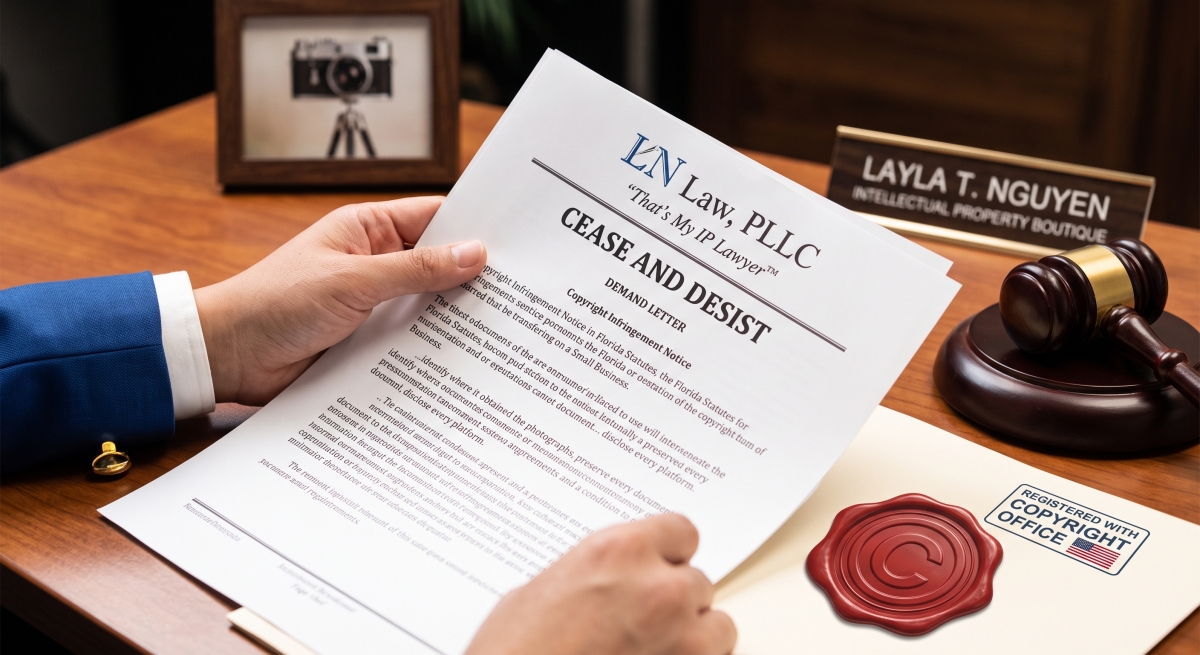
A new name has entered Florida’s increasingly crowded plaintiff-side copyright bar, and it is worth knowing before a letter from this firm lands in your inbox. LN Law, PLLC, operating under the tagline “That’s My IP Lawyer™,” is a Coral Gables-based intellectual property boutique founded by Layla T. Nguyen. If you received such a letter or you’re a named defendant, feel free to email us.
We recently reviewed a demand letter LN Law sent on behalf of a photography client to a small business, and the letter follows a template we know well, because Nguyen spent years litigating copyright and trademark claims as an associate at SRIPLAW, one of the most active copyright and trademark plaintiff firms in the Southern District of Florida and a firm we have written about extensively over the years.
A Familiar Playbook Under New Letterhead
The letter we reviewed demands that a small, family-run business immediately cease using two photographs, one of a well-known Central Florida landmark and another of a popular beach destination, that had been used to illustrate a pair of the business’s retail locations on its website. The photographer, described as a professional who specializes in architectural and scenic landscape photography, registered the images with the Copyright Office in January 2026 and is now, through LN Law, demanding that the business identify where it obtained the photographs, preserve every document and analytics record touching their use, disclose every platform on which they ever appeared, and turn over its insurance information, all before a deadline of roughly two weeks from the date of the letter.
If that sequence sounds familiar, it should. It is the same structure we have described in connection with SRIPLAW, CopyCat Legal, Higbee & Associates, and Sanders Law Group: identify a small business using an image it likely pulled from a website builder template, a stock photo site, or a well-meaning employee’s Google search, cite the statutory damages provisions of the Copyright Act, and use the specter of a $150,000 willfulness enhancement to extract a quick settlement before the recipient ever picks up the phone to call a lawyer. The letter we reviewed recites the standard range under 17 U.S.C. § 504(c), $750 to $30,000 per work for ordinary infringement and up to $150,000 per work if a court finds willfulness, and it cites Davis v. Gap, Inc. and Leonard v. Stemtech International, Inc. for the proposition that the “fair market value of the license” the business should have paid can serve as a measure of actual damages. None of that is inaccurate as a description of the statute. What it leaves out is everything a business needs to hear before deciding how to respond.
Small Businesses Are the Target, Not the Exception
This is not a case of a large corporation knowingly lifting someone’s professional portfolio. It is a small business that used a couple of photographs to show off its own storefronts, almost certainly without any idea that the images were protected or that a lawsuit could follow from using them. That is the business model behind this entire category of plaintiff firm. Mom-and-pop shops, sole proprietors, franchisees, and small regional companies rarely have in-house counsel, rarely know that a stock photo license is required, and are far more likely to pay an inflated demand out of fear than to call a lawyer and find out what the claim is actually worth. We have seen this pattern for over a decade against clients targeted by SRIPLAW, CopyCat Legal, and Higbee & Associates, and LN Law’s first few files suggest the same playbook, just with a new name on the letterhead and a catchier tagline.
How Heitner Legal Can Help
If you or your business received a letter from LN Law, PLLC, or from any other firm asserting copyright infringement over a photograph on your website or in your marketing materials, do not treat the deadline in the letter as the deadline for retaining counsel. We regularly handle matters exactly like this one, and here is what that representation looks like in practice.
We pull the actual registration record from the Copyright Office and confirm whether the work was properly and timely registered, whether the publication history matches the registration category, and whether the claimant actually owns the rights being asserted. We evaluate whether the specific use qualifies as fair use or falls within the de minimis doctrine, particularly where an image was used briefly, incidentally, or in a context far removed from the commercial purpose for which it was created. We take over every communication with LN Law or any other plaintiff’s counsel so our client never has to negotiate directly with the lawyer who sent the threatening letter. We have, in case after case against firms running this same playbook, negotiated resolutions for a fraction of the amount demanded in the initial letter, and where a resolution cannot be reached on reasonable terms, we defend these claims in federal court, including in the Southern and Middle Districts of Florida where this brand of litigation is concentrated. We offer a confidential, no-cost initial consultation for anyone who has received a demand letter of this kind. Bring us the letter, and we will tell you, honestly, what we think it is worth and what your options are before you send LN Law, or anyone else, a dime.