
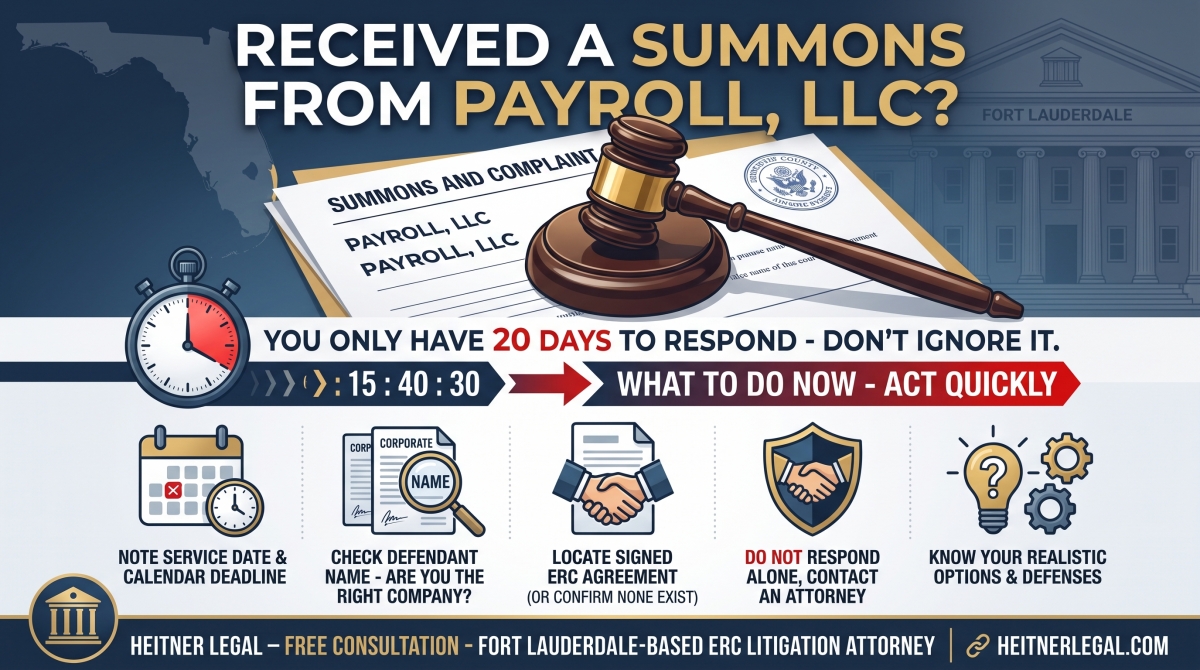
If you searched for this page, there is a good chance you or your business recently received a summons and complaint filed by Payroll, LLC in a Florida court, and you are trying to figure out what happens next. You are not alone, and you do not need to panic. But you do need to act quickly, because Florida gives you a short window to respond. Feel free to contact us.
This post explains why Payroll, LLC lawsuits are showing up in Broward County and elsewhere in Florida, what your realistic options are, and how to avoid the single most common and most costly mistake: doing nothing.
Who Is Payroll, LLC, and Why Is It Suing Businesses in Broward County?
Payroll, LLC is a Florida-based company, headquartered in Palm Beach Gardens, that markets Employee Retention Credit (ERC) preparation and filing services to small businesses nationwide. Under a typical Payroll, LLC engagement, the company agrees to waive an upfront, non-refundable retainer fee — commonly quoted at $20,000 — in exchange for a contingency fee, often 20% of any ERC funds ultimately recovered from the IRS.
The dispute pattern we are seeing, and that has been reported by other business owners, arises later. If the relationship breaks down — often because the client stops responding, disputes the scope of work, or the IRS claim is delayed, denied, or never pursued to completion — Payroll, LLC has taken the position in multiple lawsuits that the originally waived $20,000 retainer becomes immediately due and payable in full, regardless of whether any ERC funds were ever received. Businesses across the country have filed complaints describing versions of this same scenario, including allegations that they were pursued for five-figure fees despite receiving no ERC funds at all, and reports that a company representative claimed to have sued “over 400 companies already.” Whatever the merits of any individual claim, the volume of this litigation is real, and Broward County’s county court has become a frequent venue for it because Payroll, LLC’s ERC agreements typically designate Broward County as the exclusive forum.
If your business signed one of these agreements and things did not go as planned, being named as a defendant may not come as a total surprise. But a meaningful number of the businesses being sued have a different problem entirely: they never signed anything with Payroll, LLC at all.
Are You Sure Your Business Is the Right Defendant?
Before assuming the lawsuit reflects a real dispute your business had with Payroll, LLC, check one thing first: does the entity named as “Defendant” in the complaint actually match the entity that signed the ERC agreement attached to it?
We are increasingly seeing Payroll, LLC name a defendant based on a business name that closely resembles the name on the actual signed agreement, without the two being the same legal entity. A complaint might name “[Business Name] LLC” as the defendant, while the agreement attached as an exhibit was signed years earlier by a similarly — but not identically — named business, sometimes operating out of a different city, run by a different individual, with no corporate relationship between the two. In some instances, the named defendant entity was not even legally formed until well after the date the lawsuit claims the contract was signed, meaning the defendant could not possibly have entered into the agreement at all.
If any of the following is true, your business may have been misidentified rather than legitimately sued:
- The signature block on the agreement attached to the complaint does not list your company’s legal name, or lists a different signer than anyone at your company.
- Your company’s principal address does not match the address listed for “Defendant” in the complaint.
- Your company was not yet formed on the date the complaint says the agreement was signed.
This is a misnomer or mistaken-identity problem, and Florida law gives defendants real tools to address it quickly, including the possibility of recovering attorneys’ fees from a plaintiff who continues to pursue a claim after being shown it named the wrong party.
You Likely Have Only 20 Days to Respond — Do Not Ignore the Complaint
Under Florida law, a defendant generally has 20 days from the date of service to file a response to a complaint. That clock starts running the day you or your registered agent receives the papers, not the day you get around to reading them. If your business is served and no response is filed in time, Payroll, LLC can seek a default judgment, after which your options narrow considerably and become far more expensive to pursue.
Even if you believe the lawsuit was filed against the wrong company entirely, silence is not a defense. You still need to appear and raise that issue formally, on the record, within your response window.
What Is a Florida Statute § 57.105 “Safe Harbor” Letter, and How Can It Help?
Section 57.105 of the Florida Statutes allows a party to recover attorneys’ fees when a claim is not supported by the material facts, or by the law applied to those facts. Before a court can award those fees, though, the statute requires the party seeking them to first serve — not file — a proposed motion and give the opposing side 21 days to voluntarily withdraw or correct the offending claim. This is commonly called a “safe harbor” period.
For a business that was named as a defendant by mistake, a properly prepared 57.105 safe harbor letter and proposed motion can be one of the fastest and most cost-effective ways to resolve the case: it puts the plaintiff on formal notice that continuing to pursue the wrong party will expose it to a fee-shifting motion, and gives it 21 days to dismiss before that motion is filed with the court. Many claims resolve at this stage without ever reaching a motion to dismiss hearing.
You’re Not the Only One Searching for This
If you are reading this because you were just served, it is worth knowing that this pattern has drawn attention well beyond any single case. Public complaints filed with the Better Business Bureau against Payroll, LLC describe a recurring set of concerns from other business owners, including being pursued for contingency-style fees on ERC funds that were never received, and reports of digitally signed agreements the business says it never authorized. More broadly, ERC-related litigation between service providers and the businesses they served has become a well-documented national trend as the wave of pandemic-era Employee Retention Credit claims works its way through the court system. None of this means any particular claim against your business is or is not valid — every case turns on its own facts and its own contract — but it does mean you are dealing with a recognized pattern, not an isolated dispute, and that pattern often has recognized defenses.
Common Defenses in a Payroll, LLC ERC Lawsuit
Depending on the facts of your specific case, defenses that are frequently available in this type of litigation include:
- Misnomer or mistaken identity — the named defendant is not the entity that signed the agreement.
- Lack of capacity to contract — the named defendant did not legally exist on the date the agreement was allegedly signed.
- Improper execution — the agreement was signed by someone without authority to bind your business.
- Failure of a condition precedent or breach by the plaintiff — Payroll, LLC did not perform the services the agreement required before demanding the retainer fee.
- Unconscionability or ambiguity in the fee-conversion clause itself.
- Lack of personal jurisdiction, particularly for out-of-state businesses with no meaningful connection to Florida beyond the contract.
Which of these apply, if any, depends entirely on your agreement, your correspondence with Payroll, LLC, and the specific allegations in your complaint.
What to Do If You Were Served With a Payroll, LLC Complaint
- Note the exact date you or your registered agent were served — this starts your response clock.
- Locate any agreement your business signed with Payroll, LLC, or confirm that no one at your business ever signed one.
- Do not respond directly to Payroll, LLC or its counsel on your own, and do not ignore further correspondence.
- Calendar your response deadline immediately.
- Contact a Florida litigation attorney before that deadline, not after.
Free Consultation — Heitner Legal Defends Businesses Named in Payroll, LLC and Other ERC Lawsuits
Heitner Legal, P.L.L.C. is a Fort Lauderdale-based business and litigation firm founded by Darren Heitner, Esq., a Florida Bar member representing businesses in Broward County and throughout the country. We offer a free consultation to any business that has been named as a defendant in a Payroll, LLC lawsuit, or a similar ERC-related fee dispute, to help you understand your response deadline and realistic options before that deadline passes.
If you were served with a complaint filed by Payroll, LLC — whether your business is in Florida or anywhere else in the country — contact Heitner Legal for a free consultation before your response window closes.
This blog post is for general informational purposes only and does not constitute legal advice, and does not create an attorney-client relationship between Heitner Legal, P.L.L.C. and any reader. Every lawsuit depends on its own specific facts and documents, and prior outcomes in other matters do not guarantee any particular result in a future case. Payroll, LLC is entitled to pursue legitimate legal claims, and nothing in this post should be read as a statement that any specific pending claim lacks merit. If your business has been named as a defendant in a lawsuit, you should consult a licensed attorney about the specific facts of your case as soon as possible.