
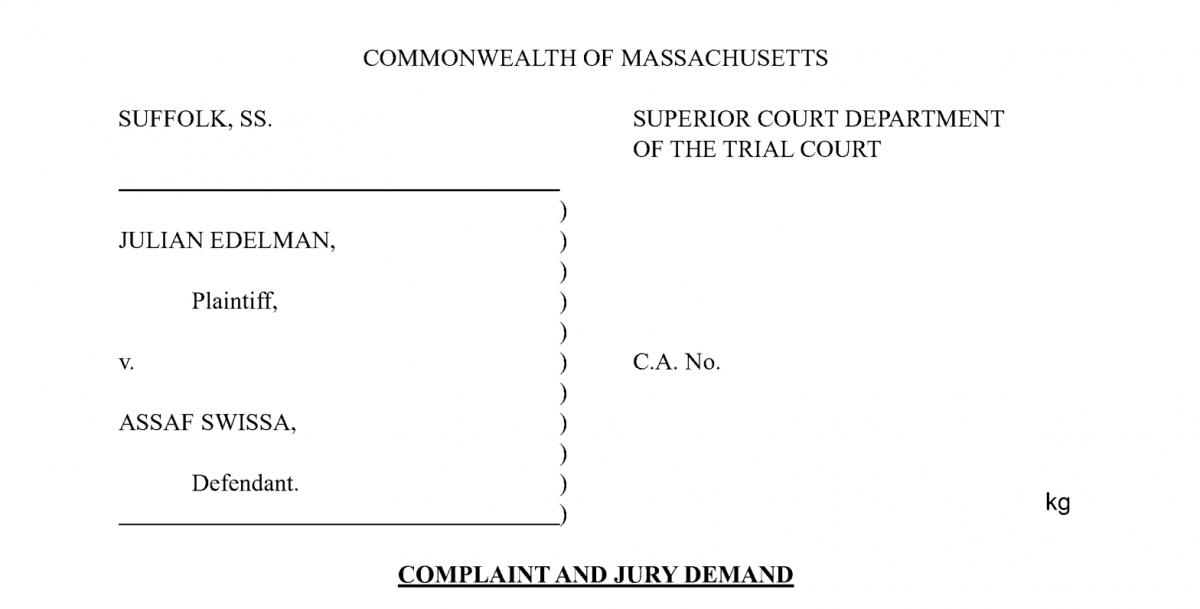
On April 17, 2026, former New England Patriots wide receiver Julian Edelman filed a complaint in Suffolk County Superior Court against Assaf Swissa, the founder of Boston-based digital advertising agency Superdigital LLC. The lawsuit, which seeks damages and a declaration that Edelman held a partnership interest in Superdigital, arises from an alleged twelve-year working relationship that culminated in Swissa selling Superdigital to Accenture Song for nearly $50 million in August 2025 without compensating Edelman in any way. The case is a striking illustration of what can go wrong when years of collaborative effort proceed based on oral assurances, mutual trust, and handshake understandings rather than a written operating agreement that spells out ownership interests and exit rights.
The Factual Narrative
The complaint states that Swissa and Edelman first connected through Swissa’s father, who operated a hair salon where Patriots players were clients. When Swissa founded Superdigital in July 2013, following his termination from a prior startup venture, Edelman became the company’s first client and its prototype for influencer marketing. As Edelman’s on-field profile exploded, Swissa leveraged Edelman’s fame, contacts, and credibility to build Superdigital into a full-service advertising agency with corporate clients that Edelman himself brought to the table.
According to the complaint, Swissa was explicit with Edelman on repeated occasions that they were “partners” and that he would “take care of” Edelman “down the road.” Swissa made these same representations to outside investors and prospective clients, pitching Superdigital and its production affiliate, Coast Productions, as a joint venture owned by both men. The complaint alleges Edelman introduced Swissa and Superdigital to several of its most consequential clients, including Microsoft, which eventually accounted for an estimated 30% to 40% of Superdigital’s annual revenue, as well as Papa Gino’s, Guy Fieri, and Hasbro. According to the pleading, Edelman obtained access to private events over the objections of his own agents, specifically so Swissa could pitch Superdigital and network with corporate executives, because Edelman believed he was growing his own business when he did so.
When Swissa sold Superdigital to Accenture Song in August 2025, Edelman learned of the transaction not from Swissa but from a third party. Superdigital was founded in 2013 and had grown into a recognized player in the digital advertising and influencer marketing space before being acquired by Accenture Song. Swissa is alleged (upon information and belief) to have personally cleared approximately $18.5 million after taxes on the transaction. Edelman received nothing. When Edelman confronted Swissa about the sale, Swissa told him they should revisit the matter “at the appropriate time.” Months later, Swissa offered to walk away from their jointly formed production company, now known as Nuthouse Sports, but extended no compensation tied to the Superdigital sale.
The Legal Claims and Why They Matter
Edelman’s counsel filed five counts: quantum meruit and unjust enrichment, a declaratory judgment seeking recognition of a partnership interest, breach of fiduciary duty, promissory estoppel, and equitable accounting.
The quantum meruit and unjust enrichment count does not require proof of a contract. Under Massachusetts law, recovery in quantum meruit is available where one party confers a benefit on another under circumstances in which it would be inequitable to retain the benefit without paying for it. The complaint alleges that Edelman provided twelve years of services that were the direct cause of Superdigital’s ability to land its most lucrative accounts and ultimately sell for $50 million. Whether a court accepts that framing will turn significantly on whether Edelman can establish a reasonable expectation of compensation, which the repeated oral promises from Swissa are designed to supply.
The declaratory judgment count will be a tough one to prove. Edelman contends that he and Swissa formed an oral partnership with respect to Superdigital and that he is therefore entitled to a proportionate share of the Accenture sale proceeds. Massachusetts recognizes that a partnership can be formed by conduct and oral agreement, without a written document or formal registration. The operative question is whether the parties agreed to carry on a business as co-owners for profit. The challenge for Edelman will be demonstrating that certain representations and conduct establish the mutual intent to co-own the business rather than an aspirational arrangement that was never formalized.
The breach of fiduciary duty count, if the partnership theory prevails, follows naturally. Partners owe each other duties of loyalty and good faith under Massachusetts law, and deliberately concealing the sale of a jointly owned business from a fellow partner to cut that person out of the proceeds would be a textbook violation of those duties. The complaint alleges that Swissa concealed the terms and timeline of the Accenture transaction for months leading up to the closing, which would go directly to willfulness.
The promissory estoppel count operates as an alternative cause of action. Even if no partnership existed as a matter of law, Edelman argues that Swissa made clear and definite promises of compensation, that Edelman detrimentally relied on those promises by forgoing other business opportunities and directing valuable corporate relationships to Superdigital rather than to ventures in which he held a formal ownership interest, and that injustice can only be remedied by enforcement of those promises. This is a common backup theory in cases where the primary contract or partnership claim is uncertain.
What Athletes and Business Partners Should Take Away
The Edelman complaint is a lesson in the risks of proceeding on goodwill and informal assurances in a business relationship, regardless of how close the personal friendship is and regardless of how clearly both parties appear to understand themselves to be working toward a shared purpose. Swissa’s public-facing statements over the years could help Edelman with the partnership narrative. Yet none of this translated into a written instrument that protected Edelman’s interest in Superdigital when the business was monetized.
Athletes who lend their names, relationships, and influence to business ventures run by associates or friends face this risk routinely. The value of a famous athlete’s involvement, which often includes access to corporate decision-makers, credibility in sales pitches, and the ability to create viral content that becomes a showcase for a creative agency’s capabilities, is real and quantifiable. But that value is seldom reduced to writing in the early days of a relationship built on friendship and mutual ambition. When the business eventually sells or succeeds in ways that make formal equity rights suddenly worth fighting over, the athlete is frequently left arguing about what was promised rather than pointing to what was documented.
The lesson is straightforward. Any arrangement in which an athlete is expected to contribute name, likeness, relationships, or active business development efforts to a venture should be memorialized in a written operating agreement before those contributions begin. That agreement should define the athlete’s membership interest, govern what happens to that interest upon a sale or change of control, require notice and consent rights before a disposition of the business, and address compensation for ongoing services. Without that documentation, the athlete’s only recourse is equitable, and while the Edelman complaint presents a sympathetic set of facts, equitable claims are harder to win, slower to resolve, and far less certain in their outcome than a straightforward breach of a written contract.
If you are someone who has contributed to a business venture without a formal written agreement documenting your ownership interest or compensation rights, contact us to discuss your options.
This post is for informational purposes only and does not constitute legal advice. Reading this post does not create an attorney-client relationship.