
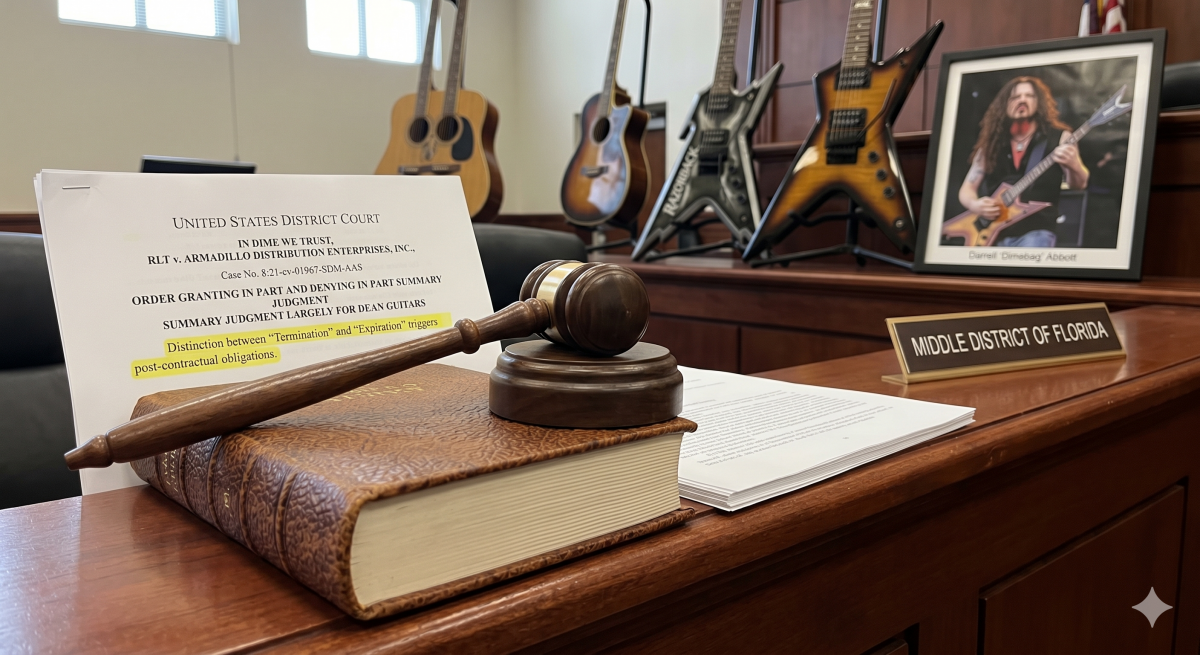
A federal court in the Middle District of Florida issued a sweeping summary judgment order in In Dime We Trust, RLT v. Armadillo Distribution Enterprises, Inc., Case No. 8:21-cv-01967-SDM-AAS, largely in favor of Dean Guitars and its affiliate Concordia Investment Partners. The plaintiffs (the estate and trust of the late Darrell “Dimebag Darrell” Abbott, the iconic Pantera guitarist murdered on stage in 2004) had pursued claims spanning trademark infringement, copyright infringement, fraud, breach of contract, and violations of Florida’s Deceptive and Unfair Trade Practices Act. The court granted summary judgment for Dean on nearly every count, leaving only two claims to proceed toward trial.
What the Case Was About
Abbott had entered a guitar endorsement deal with Dean Guitars in 2004, just weeks before his death. A restated version of that agreement was executed in 2014 with his brother, Vincent Abbott, who served as personal representative of the estate. When the restated agreement expired in June 2017, the parties continued performing informally. Dean kept selling endorsed guitars bearing Darrell’s name, image, and likeness, and continued paying royalties at the contract rate. That’s until the Trust sent a demand letter in June 2021 asserting that the agreement had terminated and that Dean’s continued use of certain marks and guitar designs constituted infringement. Litigation followed.
The Termination vs. Expiration Distinction Changed Everything
There’s a lot to unpack in the order, but perhaps the most practically significant ruling in the order involves the breach of contract claim. The Trust argued that Dean breached the restated agreement by continuing to produce Stealth and Razorback-style guitars after the agreement ended. The restated agreement contained a provision that, upon “termination,” Dean would cease production of those designs. The Trust argued the agreement had terminated, either by its own terms or through the conduct of the parties.
The court disagreed, drawing a precise distinction between “termination” and “expiration.” The restated agreement defined the “Contract Period” as concluding June 30, 2017, “unless sooner terminated or extended.” The agreement’s survival clause applied to obligations that survived “termination or expiration.” The court read these usages as intentional and distinct. “Termination” under the agreement meant the exercise of a contractual “Special Right of Termination” — a formal, written, notice-triggered act by either party. Neither party ever sent that notice. The agreement simply ran its course and expired. Because it expired rather than terminated, the contractual obligation to cease Stealth and Razorback production never triggered.
This is a distinction that parties and their counsel routinely overlook. When a post-contractual obligation is conditioned on termination rather than expiration (or on the end of the agreement by any means) the drafting choice has real consequences. The court specifically noted that conditioning post-contractual rights on the absence of termination serves a legitimate commercial purpose. It rewards full and faithful performance and deters breach.
Practical Takeaway
The words “termination” and “expiration” carry distinct legal meanings when a contract uses them deliberately and assigns consequences to each. Courts will enforce that distinction. Post-contractual obligations keyed to “termination” will not be triggered by an agreement that simply runs its course.
If you are involved in a talent endorsement deal, a name and likeness licensing arrangement, or a dispute over trademark and intellectual property rights, the structure and language of your agreements will determine the outcome. Contact us to discuss how Heitner Legal can help you protect what you have built.
This blog post is for informational purposes only and does not constitute legal advice.