
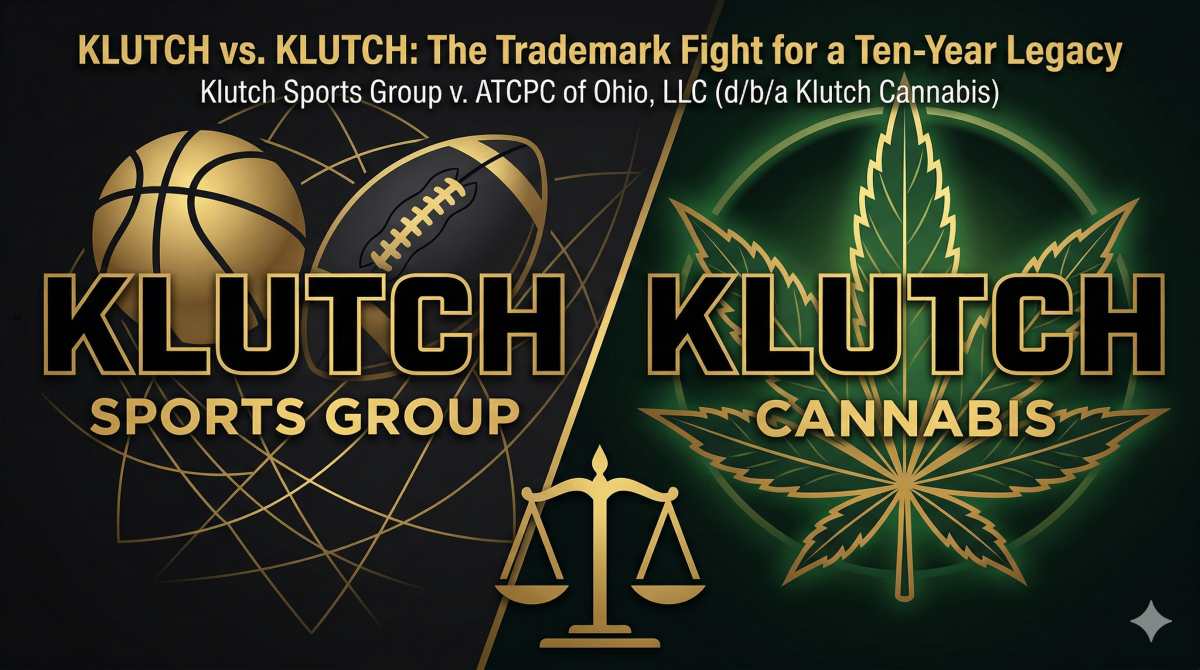
Rich Paul built Klutch Sports Group into one of the most recognizable agencies in professional sports. Now, the company is going to federal court to protect the brand it spent over a decade constructing.
On March 26, 2026, Klutch Sports Group, LLC filed a Complaint in the United States District Court for the Northern District of Ohio, Eastern Division, against ATCPC of Ohio, LLC, doing business as Klutch Cannabis. The lawsuit asserts federal trademark infringement, false designation of origin, trademark counterfeiting, unfair competition, and related state law claims arising from Klutch Cannabis’s decision to build an entire Ohio-based cannabis business around the KLUTCH name, in virtually the same black-and-gold color scheme and block letter font that Klutch Sports has used since its founding in Cleveland in 2012.
The KLUTCH Brand and What Is at Stake
Founded by Rich Paul, an Ohio native who grew up in Cleveland’s Glenville neighborhood, Klutch Sports rose from representing a handful of NBA players to managing the careers of LeBron James, Anthony Davis, and a roster of elite professional athletes across multiple sports. In 2021, Time Magazine named Klutch Sports one of the world’s 100 most influential companies. By 2025, Forbes valued it as the fifth most valuable sports agency in the country, with $351 million in maximum commissions. The KLUTCH brand has expanded well beyond talent representation into consumer apparel through Klutch Athletics, a sportswear line co-authored with New Balance that sells at Foot Locker, Dick’s Sporting Goods, JD Sports, and other major retailers nationwide.
I have written about Klutch Sports Group and Rich Paul extensively at Sports Agent Blog over the years, covering everything from the Nerlens Noel lawsuit against Rich Paul to the Excel Sports non-compete litigation involving a Klutch hire to the Mark Termini commission dispute filed in this same federal district. The brand’s legal footprint, often defending against litigation, has grown alongside its business footprint, and this trademark action is the latest chapter of its legal excapades but this time it is on the offensive.
What the Complaint Alleges
The Complaint is direct about what happened. Klutch Cannabis adopted the KLUTCH name, replicated the black-and-gold color motif, used a virtually identical bold font, and began operating brick-and-mortar dispensaries throughout Ohio, including, by August 2025, in Cleveland itself, where Klutch Sports was born. Klutch Cannabis sells cannabis products, cannabis accessories, and branded apparel, including T-shirts, sweatshirts, and hats, all under the KLUTCH name and logo.
Klutch Sports owns two federal trademark registrations central to this dispute: U.S. Registration No. 5,399,022 for KLUTCH SPORTS GROUP, which is incontestable under 15 U.S.C. § 1065, and U.S. Registration No. 6,343,533 for the KLUTCH mark itself, covering clothing including hats, T-shirts, hoodies, pants, shirts, and jackets. The incontestable status of the KLUTCH SPORTS GROUP registration is a significant legal asset. It forecloses most challenges to the mark’s validity.
The Complaint also alleges documented instances of actual consumer confusion. A commenter on a Cleveland.com article announcing one of Klutch Cannabis’s dispensary openings publicly asked whether there was any connection between Klutch Cannabis and Klutch Sports Group. During a 2025 visit by Rich Paul himself to the Cleveland dispensary, a customer in the store informed Paul he planned to purchase a Klutch Cannabis sweatshirt, believing it was affiliated with Klutch Sports. Multiple Klutch Sports employees and executives were contacted by individuals who mistakenly believed Klutch Sports owned or operated Klutch Cannabis. The Complaint further alleges that at least one Klutch Cannabis employee told someone there was a connection between the two companies.
Despite a cease-and-desist letter sent in August 2025 and despite changing legal counsel three times through January 2026, Klutch Cannabis has not rebranded.
The Causes of Action
The Complaint sets out seven counts. Counts I through III assert federal trademark infringement under Section 32 of the Lanham Act (15 U.S.C. § 1114) and false designation of origin and unfair competition under Section 43 (15 U.S.C. § 1125(a)). Count IV alleges trademark counterfeiting — a particularly serious claim — based on Klutch Cannabis’s use of a mark identical or substantially indistinguishable from Klutch Sports’s registered KLUTCH mark on apparel. Count V pleads common law trademark infringement and unfair competition under Ohio law. Count VI asserts violations of the Ohio Deceptive Trade Practices Act, O.R.C. § 4165 et seq. Count VII alleges trademark dilution under Ohio common law, contending that Klutch Cannabis’s conduct erodes the public’s exclusive identification of the KLUTCH marks with Klutch Sports and tarnishes the marks’ prestigious associations.
Klutch Sports is seeking permanent injunctive relief, disgorgement of Klutch Cannabis’s profits, treble damages for willful infringement, statutory damages under the counterfeiting provisions, punitive damages under Ohio law, and attorneys’ fees.
Key Takeaways for Brand Owners and Legal Practitioners
This case illustrates several points worth understanding.
First, an incontestable federal registration is a powerful enforcement tool. It essentially removes validity as a line of defense for the accused infringer and allows the mark owner to go straight to the likelihood of confusion analysis. At Heitner Legal, we consistently encourage our clients to seek such an incontestable status.
Second, the counterfeiting count is significant. When an accused infringer uses marks on the same categories of goods covered by a registration (here, apparel) the counterfeiting theory opens the door to statutory damages that can far exceed actual losses.
Third, actual confusion evidence, even anecdotal, meaningfully strengthens a trademark plaintiff’s hand at the preliminary injunction stage and at trial. The side-by-side logos, the identical color scheme, and the geographic overlap in Ohio all support the inference of willfulness that drives enhanced damages exposure.
Finally, the cannabis-athlete crossover market that the Complaint itself describes (citing NBA and NFL players who have publicly invested in or endorsed cannabis brands) creates a foreseeable consumer assumption that a cannabis brand named KLUTCH has something to do with Rich Paul’s agency.
That assumption, the Complaint argues, is precisely what Klutch Cannabis engineered.
Heitner Legal is not affiliated with this litigation or either party. That said, if you are a brand owner facing unauthorized use of your name, logo, or trade dress — or if you have received a cease-and-desist letter and need to understand your options — we are here to help. Heitner Legal handles trademark matters for clients across the sports, entertainment, and business communities. Contact us for a free consultation.