
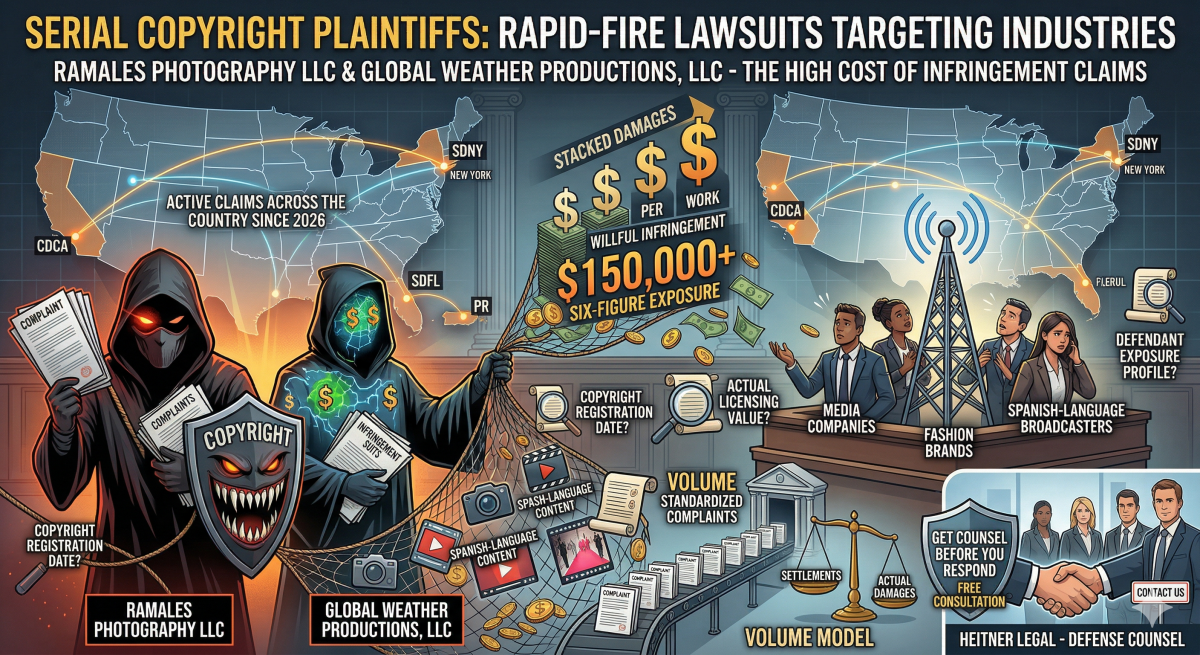
Two serial copyright plaintiffs have been active in federal courts across the country since the start of 2026, and if you operate a media company, a fashion brand, or a Spanish-language broadcasting outlet, there is a meaningful chance you are already named in one of their complaints or will be soon. Ramales Photography LLC and Global Weather Productions, LLC have each filed dozens of copyright infringement lawsuits in a short span of time, targeting a range of defendants with a model that is well established in copyright enforcement circles, and well worth understanding before you decide how to respond.
If you’re interested in a free consultation, then please contact us.
Ramales Photography LLC has been filing complaints at a rapid pace, primarily in the Southern District of New York and the Southern District of Florida, targeting media companies, fashion brands, and broadcasters. The docket reflects suits against defendants as varied as Max Mara U.S.A., Inc. in the S.D.N.Y., Spanish Broadcasting System, Inc. in the S.D. Fla., MTV Networks Inc. in the S.D.N.Y., and even individual defendants in the District of New Jersey.
Global Weather Productions, LLC has taken a parallel approach targeting Spanish-language media outlets across an even wider geographic footprint, with suits filed in the Southern and Middle Districts of Florida, the Northern and Southern Districts of California, the Northern District of Texas, the District of Maryland, and the District of Puerto Rico.
Sanders Law Group has served as counsel for Global Weather Productions, with at least one prior complaint alleging that a defendant displayed protected video segments without permission. SRIPLAW, another firm with a well-documented history of volume copyright enforcement on behalf of photographers and content creators, has also appeared in these types of campaigns. These law firms are among the firms responsible for substantial numbers of image infringement lawsuits, with media companies constituting the most frequently sued industry.
The litigation model these entities employ is not new, and courts have seen it before. Copyright trolling involves threatening numerous alleged infringers with the goal of extracting quick settlements, exploiting the fact that defending a federal copyright lawsuit is expensive and exposes defendants to high statutory damages. The business rationale is straightforward: most defendants will pay a settlement that sits below the cost of litigation rather than fight. The model depends on volume, with enforcement operations sending thousands of letters and filing dozens of complaints while counting on a response rate that generates substantial revenue.
What makes these campaigns particularly aggressive is that copyright law does not require a plaintiff to prove actual losses to recover meaningful sums. Under 17 U.S.C. § 504(c)(1), a copyright owner may elect to recover statutory damages instead of actual damages, for not less than $750 or more than $30,000 per work, as the court considers just, and where the court finds that infringement was committed willfully, that ceiling rises to $150,000 per work. When a complaint alleges infringement of multiple works, those per-work figures stack. A defendant facing claims involving five photographs or five video clips is looking at potential exposure well into the six figures before any litigation costs are factored in.
That exposure is precisely what serial plaintiffs and their counsel leverage when they make their initial settlement demands. Defendants who receive a complaint or a demand letter in these campaigns face a genuine strategic calculation, and the right answer is rarely to ignore it or to pay immediately without understanding what they are actually conceding.
Several threshold issues warrant investigation before any response is made.
First, whether the plaintiff’s copyright registrations predate the alleged infringement matters enormously, because statutory damages are not available unless the work was registered before the infringement commenced or within three months of first publication.
Second, the actual licensing value of the work is relevant to the reasonableness of any settlement figure. When copyright troll cases proceed to judgment, courts and juries often look at both the amount of actual damages and the conduct of both parties, and where an image carries a nominal licensing fee and the infringement generated little revenue for the defendant, courts have been reluctant to award maximum statutory damages absent egregious behavior.
Third, ownership chain questions, particularly with photographic works or footage that may have passed through assignment or license agreements before reaching the plaintiff entity, can be fertile ground for a defense. Serial litigants have faced scrutiny when they could not demonstrate a legitimate licensing business, and courts have treated them with measurable skepticism.
None of this means that the underlying infringement claim is necessarily invalid. If your company used a photograph without a license, or if a video clip appeared on your broadcast or social media channel without authorization, the copyright holder may well have a legitimate grievance. The question is how to resolve it efficiently, on terms that accurately reflect the actual harm and the actual value of the work, rather than on the inflated terms that an opening demand letter is designed to extract. Whether the right path is a negotiated settlement, a license retroactive to the date of first use, a motion to dismiss on threshold legal grounds, or full defense litigation depends on the specific facts, the strength of the plaintiff’s registration chain, the number of works at issue, and the defendant’s own exposure profile.
If your business has received a complaint or a demand letter from Ramales Photography LLC, Global Weather Productions, LLC, SRIPLAW, Sanders Law Group, or any other party asserting copyright infringement based on photographs or video footage, the time to get counsel involved is before you respond. The framing of your initial response can affect your negotiating position, your exposure to a willfulness finding, and the ultimate cost of resolving the matter. Heitner Legal represents defendants in copyright disputes and has worked with clients who found themselves on the receiving end of exactly these kinds of enforcement campaigns. If you would like to discuss your situation, reach out to us.