
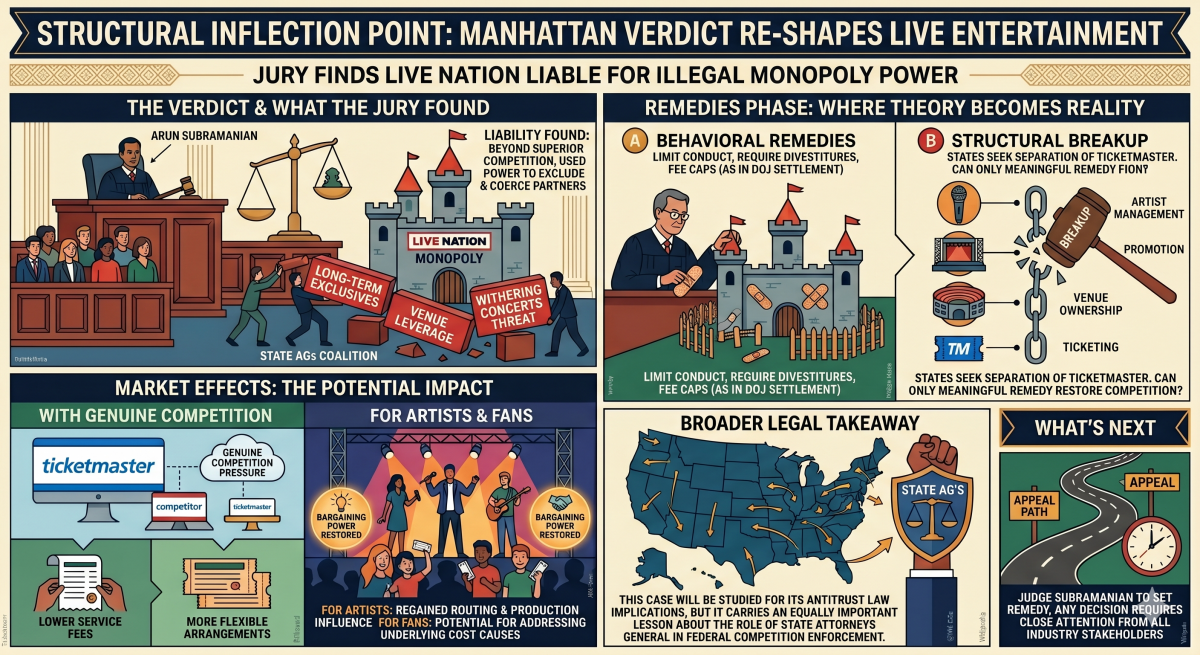
Yesterday’s verdict out of Manhattan federal court is not simply a bad day for Live Nation. It is a structural inflection point for the entire live entertainment industry, and anyone with a stake in how concerts are promoted, tickets are sold, or venues are operated should be paying close attention to what comes next.
A Manhattan federal jury found Live Nation Entertainment and its Ticketmaster subsidiary liable for illegally maintaining monopoly power in the live events and ticketing business, handing a coalition of state plaintiffs a landmark victory after a trial that stretched roughly six weeks and a deliberation process that lasted four days. The verdict did not arrive in a vacuum.
What the Jury Actually Found
The liability finding rests on the states’ theory that Live Nation did not simply grow large through superior competition. States argued during closing arguments that Ticketmaster controlled 86% of the concert market, and 73% when sports venues were included, and that Live Nation kept building a “moat around the monopoly castle” through long-term exclusives, venue leverage, and the threat of withholding concerts from venues that switched ticketers. Live Nation’s defense was that size is not a crime. Defense counsel David Marriott argued that the company’s dominance was a testament to its strategy over decades, and that being the biggest entertainment company and ticketer in the country is not against the antitrust laws of the United States. The jury disagreed.
Under the Sherman Act and applicable state equivalents, winning a monopoly through superior products, business acumen, or historical accident is not unlawful. What is unlawful is using monopoly power to exclude rivals, coerce partners, and perpetuate dominance through means that have nothing to do with competing on the merits. The jury’s verdict signals that it accepted the states’ evidence that Live Nation crossed that line.
The Remedies Phase Is Where This Gets Consequential
With the verdict decided, attention turns to U.S. District Court Judge Arun Subramanian, who must determine whether to order Live Nation to sell off Ticketmaster. This will occur after the states make a remedy proposal, which is expected in the coming weeks.
Judge Subramanian may decide that remedies short of a full breakup would satisfactorily limit Live Nation’s monopoly, including requirements limiting specific business practices instead of structural divestiture. Courts are typically reluctant to order corporate breakups, viewing them as complex, disruptive, and difficult to supervise. But the states have been explicit that structural relief is the goal. The question for Judge Subramanian is whether behavioral remedies, essentially prohibitions on the conduct the jury found anticompetitive, can actually restore competition in a market this consolidated, or whether the only meaningful remedy is separation.
Pricing, Competition, and What Fans and Artists Can Actually Expect
If structural relief is ordered and Ticketmaster is ultimately separated from Live Nation’s promotion and venue businesses, the market effects would be substantial. An independent Ticketmaster, competing for venue contracts without the implicit threat of concert routing decisions behind it, would face genuine pressure to offer better terms, lower service fees, and more flexible arrangements. Competing ticketing platforms that have struggled to break into major venues precisely because of the leverage Live Nation could exercise would have a real opportunity to compete.
For artists, the implications run deeper. The bundling of promotion, venue access, and ticketing into a single corporate structure has long given Live Nation outsized influence over routing, production deals, and even management relationships. A market with genuine competition at the promotion and ticketing levels would restore bargaining power that has eroded over fifteen years since the 2010 merger.
For fans, the direct financial impact depends heavily on the remedy.
The Broader Legal Takeaway
This case will be studied for its antitrust law implications, but it carries an equally important lesson about the role of state attorneys general in federal competition enforcement. This case proves that coalition litigation by state attorneys general can carry a case through a verdict even after federal authorities have exited.
Live Nation has signaled it will fight. In its post-verdict statement, the company pointed to several outstanding motions still left for the judge to decide, including the potential dismissal of expert testimony cited by the jury, and stated that it can and will appeal any unfavorable rulings on those motions. That appeal path is long. In the interim, Judge Subramanian will be setting the terms of whatever remedy ultimately reshapes this industry.
Heitner Legal, P.L.L.C. represents clients across the sports and entertainment industries, including in matters involving venue agreements, artist representation, and live event contracting. If you have questions about how developments in this case may affect your business or your rights, contact us.
This post is provided for informational purposes only and does not constitute legal advice. No attorney-client relationship is formed by reading this content. For advice specific to your situation, please consult qualified legal counsel.