
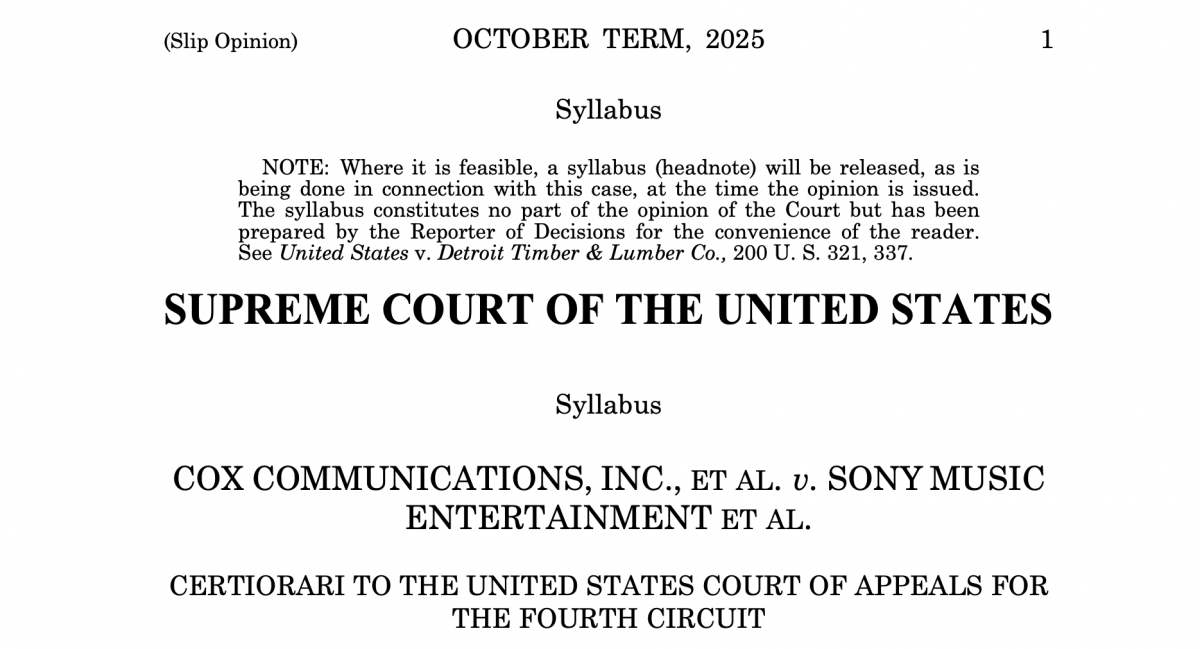
The Supreme Court handed down a landmark copyright decision on March 25, 2026, that will reshape how courts analyze contributory infringement claims against internet service providers and potentially beyond.
In Cox Communications, Inc. v. Sony Music Entertainment, the Court reversed a $1 billion verdict against Cox and made clear that simply knowing your service is being used for copyright infringement is not enough to trigger secondary liability.
Sony Music hired a third-party monitoring company called MarkMonitor to track online piracy. Over roughly two years, MarkMonitor sent Cox over 163,000 notices identifying subscriber IP addresses allegedly associated with copyright infringement. Cox had a graduated response system, which included warnings, suspensions, and eventual termination, but Sony argued that Cox wasn’t doing enough and sued for contributory and vicarious liability.
A jury awarded Sony $1 billion in statutory damages. The Fourth Circuit affirmed on contributory liability, reasoning that supplying a service with knowledge that it will be used for infringement is sufficient to establish liability.
The Supreme Court disagreed.
Writing for the majority, Justice Thomas held that a service provider is contributorily liable only if it intended for its service to be used for infringement. That intent can be shown in exactly two ways:
- Inducement — the provider actively encouraged or promoted infringement through specific acts (think Grokster, where file-sharing companies marketed their product as a piracy tool); or
- Tailored service — the service is not capable of substantial or commercially significant noninfringing uses (the flip side of the Sony Betamax rule).
Cox satisfied neither standard. It never promoted infringement. It repeatedly discouraged it through warnings and terminations. And its product (internet access) is clearly capable of substantial lawful use.
The Fourth Circuit’s standard (knowledge plus inaction) was flatly rejected. The Court emphasized what it has said repeatedly, which is that mere knowledge that a service will be used to infringe, without more, cannot establish the intent required for contributory liability.
If you’re a defendant facing a contributory copyright infringement claim, this decision is significant for several reasons:
Knowledge alone is not liability. Receiving notice that your platform, service, or product is being misused does not automatically make you a copyright infringer. Courts cannot bootstrap liability purely from awareness without evidence of intent to facilitate infringement.
The DMCA safe harbor doesn’t define the liability floor. Sony argued that because the DMCA rewards ISPs who implement repeat-infringer policies, there must be underlying liability to protect against. The Court rejected that reasoning. The DMCA created new defenses, not new liability.
The Grokster and Sony Betamax framework still governs. If your service has substantial noninfringing uses and you didn’t design it for or market it toward infringement, contributory liability has a very high bar under this decision.
Justices Sotomayor and Jackson concurred in the judgment but wrote separately to push back on the majority’s reasoning. Sotomayor argued the majority unnecessarily closed the door on other common-law theories of secondary liability, particularly aiding and abetting, that prior precedent had left open.
Their concurrence is worth watching. While they agreed Cox couldn’t be held liable on these facts (Cox didn’t know who was infringing, only which IP address was flagged, making specific intent impossible to establish), they preserved the argument that a different set of facts could support liability under an aiding-and-abetting theory. Plaintiffs and copyright owners will almost certainly try to exploit that opening in future cases.
Cox v. Sony Music is a major win for internet infrastructure providers and, more broadly, for any business that offers a general-purpose service that can be misused. It reaffirms that secondary copyright liability requires proof of intent, not just awareness, and that courts should not extend liability beyond the two well-established forms recognized in Grokster and Sony.
For content creators and rights holders, the decision is a reminder that the primary infringer remains the primary target. Pursuing platforms and providers through contributory liability requires more than a paper trail of notices. It requires evidence that the provider actively wanted infringement to occur.
We’ll continue monitoring how lower courts apply this ruling. If you have questions about copyright infringement, secondary liability, or protecting your intellectual property, contact Heitner Legal.