
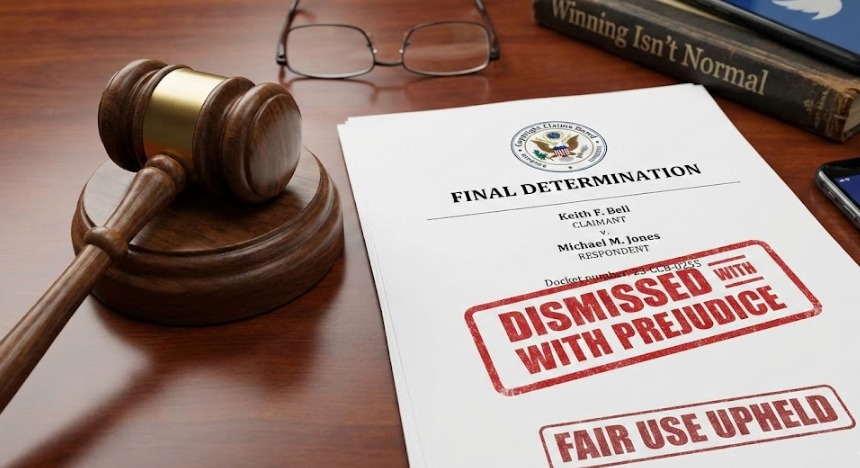
Heitner Legal is proud to announce a decisive victory on behalf of our client, Mac Jones, quarterback for the San Francisco 49ers. On December 2, 2025, the U.S. Copyright Claims Board dismissed with prejudice all claims brought against Jones by psychologist Keith Bell, finding that Jones’s use of Bell’s copyrighted material constituted fair use under copyright law.
Background of the Dispute
The case centered on a Twitter/X post that Jones made in 2016 when he was just a 17-year-old high school student. Jones posted approximately one page from Bell’s book Winning Isn’t Normal, known as the “WIN Passage” (a motivational statement about the hard work required to achieve success in sports). Jones shared this passage with the simple intention of inspiring other young athletes.
Bell, who describes himself as a sports psychologist and author of the 1982 book from which the WIN Passage derives, discovered the post in 2020 (four years after it was published). Rather than reaching out immediately, Bell waited until August 2022 to send a cease-and-desist letter demanding a staggering $249,975 in compensation. By that time, Jones had become the starting quarterback for the New England Patriots.
The Board’s Decision: A Textbook Fair Use Case
In its Final Determination, the Copyright Claims Board conducted a thorough fair use analysis and found that all factors weighed decisively in Jones’s favor:
Non-Commercial Use: The Board emphasized that Jones’s post was purely motivational and non-commercial. As a high school student sharing an inspirational message, Jones was not selling any product or service, nor was he attempting to profit from the post. The Board rejected Bell’s creative argument that, because Jones later became a professional athlete, the post somehow became retroactively commercial because it might have enhanced his “celebrity profile.”
Minimal Copying: Jones shared only about one page from Bell’s 73-page work (approximately 1.5% of the entire book). The Board found this to be a very small portion of the copyrighted work.
No Market Harm: Perhaps most significantly, Bell failed to provide any evidence of actual losses or market harm. Despite claiming that billions of people could have seen the post, Bell admitted the tweet received only 18 retweets and 65 likes. The Board found no plausible scenario in which Jones’s high school tweet would have replaced sales of Bell’s book or deprived Bell of licensing revenue.
Free Distribution by Author: The Board also noted that Bell himself has widely distributed the WIN Passage freely on the internet for many years, undercutting any claim that Jones’s use harmed a potential licensing market.
A Pattern of Frivolous Litigation
The Board’s decision comes against the backdrop of what multiple courts have characterized as Bell’s troubling litigation pattern. We actually wrote about Bell’s behavior in the past. According to court records, Bell has filed more than two dozen lawsuits over the WIN Passage, predominantly targeting public schools, nonprofits, and individuals who shared the motivational text on social media.
Federal courts have been increasingly critical of Bell’s approach. In a recent case involving LSU head football coach Lane Kiffin, U.S. District Judge Michael P. Mills questioned whether he was dealing with a litigant with their feet firmly planted on the ground, noting Bell’s extraordinary claim that the WIN Passage is likely the most widely read literary work in history, a statement the judge wryly suggested Shakespeare, Tolstoy, and Faulkner might dispute.
The Fifth Circuit Court of Appeals has described Bell as a serial litigant making exorbitant demands in hopes of extracting disproportionate settlements. Multiple courts have characterized Bell’s litigation strategy as akin to copyright trolling, systematically scouring the internet for de minimis uses of the WIN Passage and then demanding outrageous settlements.
A Warning for Future Cases
Significantly, the Copyright Claims Board concluded its decision with a stern warning to Bell. The Board put Bell on notice that continuing to pursue claims regarding the WIN Passage under similar fact patterns could constitute pursuing claims for a harassing or improper purpose, or without a reasonable basis in law or fact. Such conduct could result in findings of bad faith and potential awards of costs and attorneys’ fees to defendants.
The Board echoed Judge Mills’s concern that courts should not be used as forums for abusive shakedown lawsuits, making clear that such practices undermine the integrity of the judicial system.
What This Means for Fair Use
This decision reinforces important principles about fair use in the digital age. Sharing brief excerpts of copyrighted material for genuinely inspirational or motivational purposes, without commercial intent, falls squarely within the protections of fair use, especially when the copyright holder has widely distributed that same material for free.
The decision also serves as a reminder that not every use of copyrighted material constitutes infringement, and that copyright law is not intended to be weaponized to extract settlements from individuals engaging in harmless, non-commercial sharing of inspirational content.
Heitner Legal’s Representation
We are honored to have represented Mac Jones in this matter. Our firm is committed to defending our clients against meritless copyright claims and ensuring that fair use protections remain robust and meaningful.
Heitner Legal, P.L.L.C. represents athletes, entertainers, and businesses in intellectual property, entertainment law, and sports law matters. For more information about our services, please contact our office.