
Caleb Williams had himself a season. He led Chicago to an NFC North title and earned the nickname that now defines his brand: the Iceman.
Now he’s trying to own it. And that’s where things get complicated.
The Trademark Filings
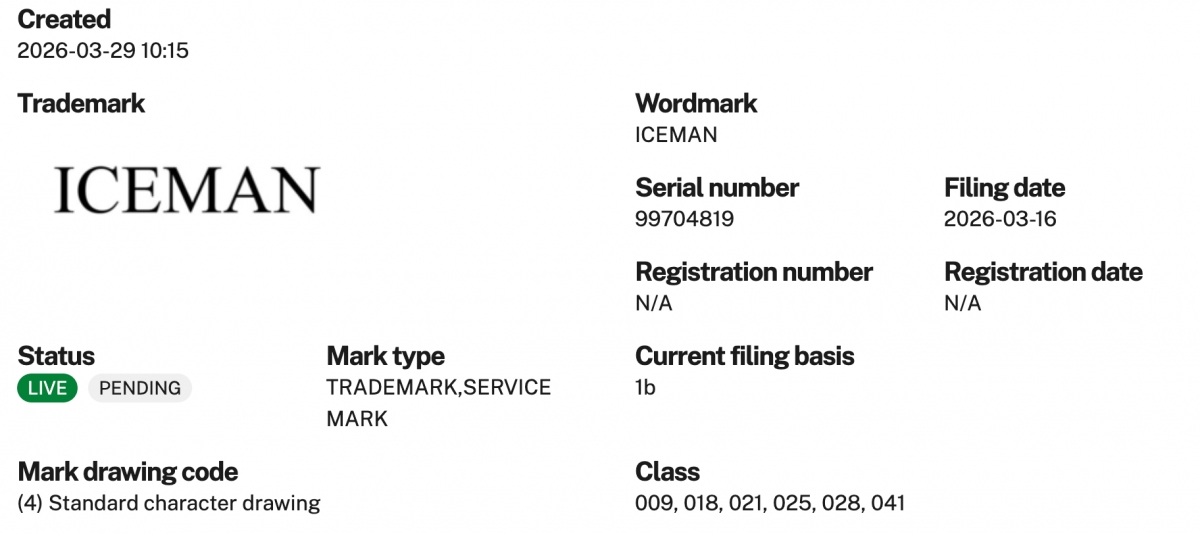
On March 16, 2026, Caleb Williams Holding Inc. filed four trademark applications with the United States Patent and Trademark Office (USPTO) related to the “Iceman” nickname. The filings covered a wide range of goods and services, including apparel (sweatshirts, T-shirts, hats, jerseys, jackets, vests), sporting goods, footballs, eyewear, sunglasses, water bottles, mugs, bags, backpacks, luggage, downloadable posters, and digital trading cards. Two of the applications covered the “Iceman” name itself (one with a unique design element), and two covered a silhouette of Williams’ mid-throw on that iconic playoff play.
Williams was ready to build a brand around the moniker, and he wanted legal protection to do it.
Then, four days later, George Gervin had something to say about that.
Enter the Original Iceman
George Gervin is a Basketball Hall of Famer, a four-time NBA scoring champion, a 12-time All-Star in both the NBA and ABA, and a member of the NBA’s 75th Anniversary Team. He has been known as “the Iceman” since approximately 1979, which is roughly 22 years before Caleb Williams was born.
On March 20, Gervin Interests LLC filed two trademark applications of its own: one for “Iceman” and one for “Iceman 44,” the latter a nod to his retired jersey number. Gervin told ESPN he was “caught off guard” by Williams’ filing, adding: “I’ve been the Iceman for 40-something years. I never thought anybody would try to trademark it.”
Gervin’s camp said the delay in filing was the result of an internal miscommunication. The president and CEO of Gervin Global Management, Jerald Barisano, told the Chicago Sun-Times that he mistakenly believed a trademark had already been secured, with that confusion stemming from the death of a business associate.
Still, despite his personal respect for the young quarterback, Gervin made his position clear: “He’s already proved greatness and his potential upside is great. Like an ‘Iceman.’ But that name is taken… All I’m saying is: Young fella, we’ve already got one ‘Iceman.'”
The Chuck Liddell Wrinkle Nobody Saw Coming
UFC legend Chuck Liddell filed for the trademark “Chuck ‘The Iceman’ Liddell” back in 2023. That application is still pending. The USPTO could decide Liddell’s pending mark is confusingly similar to both Williams’ and Gervin’s applications and use it as grounds to refuse both.
Trademark law in action doesn’t always reward the most famous, the most deserving, or even the one with the longest claim to a name. It often rewards the one who did the legal work correctly and on time, but rights in the U.S. are subject to who used intellectual property first in commerce.
How the USPTO Will Sort This Out
This is the battle of priority of use versus priority of filing.
Williams filed first, which gives him a filing date advantage, and under U.S. trademark law, that matters. However, the USPTO also recognizes common law trademark rights, which are acquired through actual use of a mark in commerce, not through registration. Gervin can argue, with substantial evidence, that he has been using the “Iceman” mark in connection with goods and services since the late 1970s, decades before Williams filed anything. If Gervin can demonstrate prior use in commerce (merchandise, licensing, appearances tied to the brand), he may have a viable claim to priority regardless of who filed first.
The USPTO will evaluate the applications individually. Examiners will conduct a likelihood of confusion analysis under the Lanham Act, comparing each application against all existing marks on the register, including Liddell’s. The more similar the goods and services, the more likely the USPTO is to find confusion. And since all three athletes are selling or plan to sell consumer goods under the same or similar nickname, the overlap is hard to avoid.
These things move slowly. It could be many months before the agency acts on any of these applications, and any denial triggers an appeal process that could extend things further.
What Every Athlete Should Take Away From This
I’ve been working in the NIL and sports IP space for years, and this situation is a perfect illustration of why proactive trademark strategy matters, both for emerging athletes and for legacy figures who have built valuable brands over decades.
If you’ve earned a nickname that fans associate with your performance, your personality, or your brand, that nickname has commercial value. Filing a trademark application is not expensive in the grand scheme of things. Litigating over one after a dispute has materialized or watching someone else register what you believe is your mark costs significantly more in time, money, and brand equity.
For Williams, the situation is recoverable. He filed first, he has a strong factual basis for the nickname, and he has the legal resources to see this through. But it didn’t have to be a dispute at all. Had his team done a more thorough clearance search before filing, Gervin’s long history with the name would have surfaced immediately, and a proactive conversation could have led to a licensing arrangement, a co-existence agreement, or a different branding strategy altogether.
For Gervin, the lesson is that you can have the most legitimate claim in the world, but if you don’t protect it, if you assume someone else handled it, or that fame alone is sufficient protection, you’re exposed.
This is exactly why you work with a qualified IP attorney before you announce your trademark plans on social media.
In Sum
Caleb Williams is an elite quarterback with a legitimate and well-earned brand. George Gervin is a Hall of Famer with over four decades of association with one of the coolest nicknames in sports history. Chuck Liddell filed a trademark nobody was talking about until this week. And the USPTO is now tasked with sorting out who gets to commercially own the word “Iceman.”
I wouldn’t bet against Gervin’s prior use argument, particularly if his team can document decades of commercial use tied to the nickname. But this is going to take time, and there’s a real scenario where neither Williams nor Gervin walks away with an approved registration.
In the meantime, if you’re an athlete, entertainer, or influencer who has built equity around a nickname, a phrase, a logo, or a look, and you haven’t had a conversation with an IP attorney about protecting it, now is a very good time to have that conversation.
Darren Heitner is the founder of Heitner Legal, P.L.L.C., a Fort Lauderdale-based law firm concentrating in sports law, NIL, intellectual property, and entertainment law. For trademark and IP inquiries, contact Heitner Legal directly.